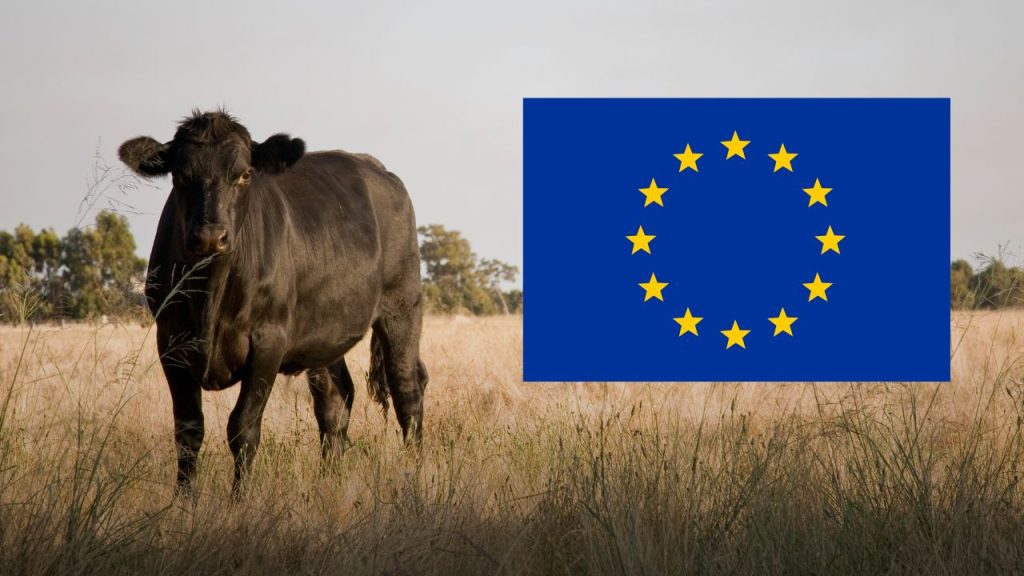
The Australian Meat Industry Council (AMIC) has expressed extreme disappointment with the outcome of the European Australia Free Trade Agreement (FTA), which locks in restrictive red meat access, resulting in a permanent competitive disadvantage for Australian meat to the EU.
The volumes and conditions attached to beef, sheep and goat meat trade to the European Union under this FTA limits, rather than supports trade into this important market of 450 million consumers.
The details are particularly hard to stomach for an industry which is already under attack from global trade restrictions and facing significant increases to the taxes charged by the Australian Government on meat exporters.
Tim Ryan, AMIC CEO, said the outcome was a kick in the guts to the Australian red meat industry.
“The meat industry has worked tirelessly and been very clear with the Australian Government about the importance of a meaningful outcome in an agreement with the European Union. This outcome is worse than those achieved by Australia’s competitors, and it caps and restricts Australia’s trade. This announcement comes at a time when the Australian Government has proposed to significantly increase taxes on meat exports despite major losses in market access and significant global trade headwinds,” Mr Ryan said.
EU FTA outcome
AMIC has consistently supported the objective of reaching a comprehensive trade agreement with the EU. However, AMIC has been equally clear that any agreement must deliver commercially meaningful access for Australian beef, sheepmeat and goatmeat to be considered in the national interest.
“When it comes to red meat, the final package locks in and solidifies the long-standing access imbalance faced by Australian exporters to the EU,”
A beef volume of 30,600 tonnes (locked at only 10,200 tonnes for the first 5 years or at least 2032) falls short of the 50,000 tonnes of beef access that was achieved by Australia’s competitors. The 25,000 tonnes of sheepmeat and goatmeat access (starting at only 8,300 tonnes) is a world away from the 67,000 tonnes the industry had indicated as a ‘pass mark’ (noting NZ gained access for 163,769 tonnes).
“We have been clear that this agreement represented a once-in-a-generation opportunity to reset red meat access to the EU in a way that would shape trade for decades to come,”
“An FTA should promote trade, not constrain it. This outcome does not reflect the contribution of the red meat sector to Australia’s economy or export profile.”
Loss of Australian meat market access
This EU FTA outcome comes at a time when Australian red meat is facing major challenges, including significant trade losses and reductions in our access to key overseas markets.
Mr Ryan said, “This disappointing outcome adds to a material deterioration in market access for Australian red meat over the last eighteen months in established and emerging markets.”
This includes the loss of around a billion dollars in beef trade to China (Australia’s second largest beef market) under the China’s global safeguard measure; critical trade to Indonesia heavily restricted for beef and effectively banned for sheep meat under punitive Indonesian import licensing arrangements; emerging barriers to trade arising for our vital trade to the US and India, and significant shipping, logistics and supply chain disruptions associated with the war in the Middle East.
My Ryan said, “The EU FTA outcome is particularly hard to swallow in the context of the sustained loss of access and significant emerging barriers to Australian red meat’s trade to global markets. The agreement locks in a comparative disadvantage at a time the Government is losing, rather than gaining, access to overseas markets that are critical to the long-term sustainability of the red meat industry.
Government increasing export taxes and walking away from its market access responsibilities
This announcement also comes in the middle of the implementation of revised cost recovery arrangements pushed out by the Albanese Government which has demonstrated the government is walking away from agricultural market access and productivity.
AMIC has previously raised our serious concerns with the proposals outlined in the draft Cost Recovery Implementation Statements issued by the Department of Agriculture, Fisheries and Forestry (DAFF) which propose significant increases in the taxes charged to red meat export businesses and a walking away from government funding of critical market access and maintenance functions.
“The Government’s proposal is for Australian agricultural exporters to be taxed at an increasingly unsustainable level with no end in sight, systemically eroding Australia’s competitiveness in international markets. Government must put its money where its mouth is when it comes to supporting agricultural productivity and market access.”
“DAFF is the exclusive provider of critical regulatory services that enable the sale of Australian meat to global markets. Australian meat exporters are already up against heavily subsidised global competitors, with lower or no government export fees. The Albanese Government is adding even more costs onto agribusinesses at a time of substantive global instability.”
While AMIC has called for an independent review of the expenses driving these increases, in light of the poor EU FTA outcome and significant losses to market access for Australian meat, AMIC urgently calls on the government to review its regulatory impact and the proposed significant increases in cost recovery fees and charges.
ENDS
About AMIC
The Australian Meat Industry Council (AMIC), is the sole Peak Industry body representing the meat industry, including processors, smallgoods manufacturers, wholesalers and distributors through to independent retail butchers and exporters.
Media contact:
Jemma Harper – General Manager Corporate Affairs
M: 0429 040 128
E: [email protected]